The Bitcoin halving 2024 explained simply.
The Bitcoin halving is an event that happens approximately every four years, reducing the reward that miners receive for verifying Bitcoin transactions. The most recent halving took place in 2024.
This maximum supply is a significant advantage compared to traditional money. The limitation prevents unwanted inflation. But how is it ensured that there will never be more than 21 million Bitcoins? And how is this maximum supply related to the halving? To understand this, let’s first take a closer look at the halving.
The cryptocurrency Bitcoin is based on blockchain technology. Essentially, you don’t need to understand the blockchain in detail for this topic. What’s important is that the blockchain specifies how new Bitcoins are created and ensures that there will never be more than 21 million of them.
So-called miners keep the blockchain running by validating transactions. These miners solve complex mathematical problems (hashes) with their computers, which requires energy in the form of electricity. As a reward for their work, they receive Bitcoins. This reward is halved every four years. The day this halving occurs is called the “Halving.”
For example, in 2009, a miner would have received 50 Bitcoins as a reward. After the most recent Bitcoin halving in April 2024, this reward was again reduced by 50%, from 6.25 Bitcoins per block to 3.125 Bitcoins. By the way, it is assumed that all 21 million Bitcoins will be created by the year 2140. After that, there will be no more halvings.
When the number of newly created Bitcoins is halved, the Bitcoin inflation rate is also halved. As a result, if demand remains constant, the market price tends to rise. At the same time, the costs for Bitcoin miners increase, which pushes them to sell their newly mined Bitcoins at higher prices.
Starting from the 2024 halving, approximately 164,250 new BTC are introduced to the market annually. With around 19 million Bitcoins already mined, this represents only about 0.86% of the total supply. This means that the supply effect relates to less than 1% of the total Bitcoin supply. Therefore, one cannot assume that the halving alone has a massive impact on the Bitcoin price. However, if we look back at past halvings, a price increase has followed each event.
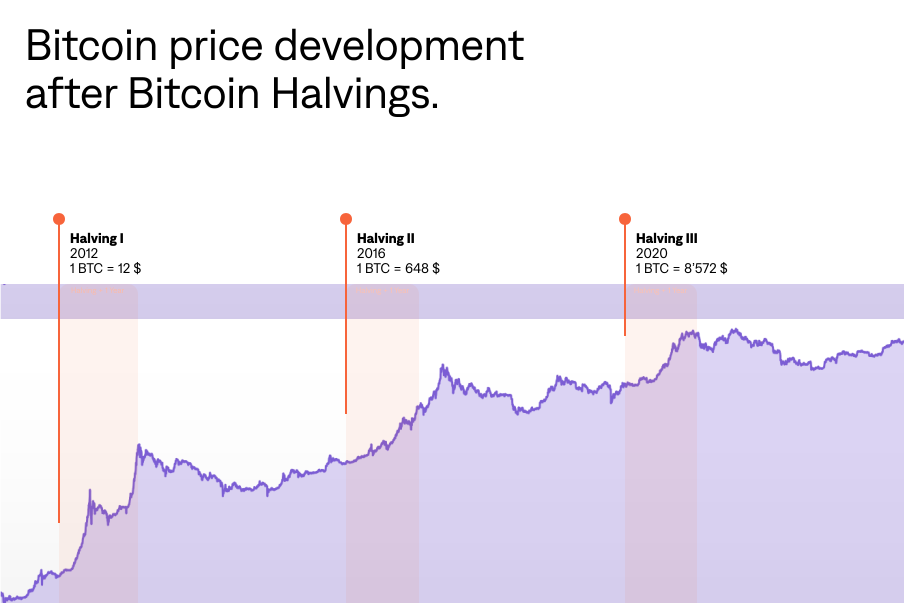
The mere change in supply may not be enough to cause a price increase. Some opinions suggest that the Bitcoin price rises whenever global liquidity provided by central banks increases – a pattern that has also appeared in four-year cycles since Bitcoin’s inception.
Another reason for post-halving price increases is the media attention it generates. Each halving triggers speculation and hype, which often leads to more people buying Bitcoin – a phenomenon also known as FOMO (Fear of Missing Out).
With each halving, mining becomes more expensive, which forces inefficient miners out of the competition. This increases the cost of running the Bitcoin network and makes it exceedingly costly to attack the blockchain. In this way, halvings contribute to greater network security.
Additionally, halvings increase the fixed costs for miners. Mining remains profitable in the long run only if the value of Bitcoin continues to rise. If traditional fiat currencies (such as USD or EUR) experience sustained inflation, a Bitcoin price increase becomes even more likely.
It can be debated whether a halving has a decisive short-term impact on the Bitcoin price. What is clear, however, is that every past halving has been followed by a long-term value increase in Bitcoin.
This article constitutes neither investment advice nor a solicitation to buy or sell crypto-assets or other financial instruments or to enter into any other financial transactions. The primary purpose of this article is to provide general information. No representations or warranties, express or implied, are made regarding the fairness, accuracy, completeness, or correctness of this article or the opinions contained therein. Therefore, it is not advisable to rely on the fairness, accuracy, completeness, or correctness of this article or the opinions contained therein. Some statements in this article may contain forward-looking expectations based on our current assessments and assumptions. These statements are subject to uncertainties and may cause actual results, performance, or events to differ from the statements made in this article.
Cryptonow and all persons advising or representing it cannot be held liable in any way for this article. It is important to note that investments in crypto-assets carry both risks and opportunities.