Ethereum explained simply.
Ethereum is currently one of the leading cryptocurrencies. We will show you the difference compared to Bitcoin. Ethereum not only has the potential to revolutionize the financial sector but also how we use data and applications on the internet. Here you will find everything you need to know before buying Ethereum.
Ethereum is a platform for decentralized applications (dApps) based on blockchain technology. It was developed by Vitalik Buterin in 2015. Unlike Bitcoin, which is primarily used as a digital payment method, Ethereum is a platform for developing decentralized applications. This allows developers to create and run their own applications without relying on a central authority.
Ethereum is based on innovative blockchain technology, similar to Bitcoin, but it offers key advantages and differences that make it the preferred choice for smart contracts and decentralized applications (dApps). Ethereum allows developers to create dApps and self-executing contracts, known as smart contracts. This enables complex business processes and contracts to be securely and transparently represented on the blockchain.
The Ethereum ecosystem has its native token called Ether, which serves as the payment method for decentralized dApps and smart contracts on the platform. ETH is traded globally on various cryptocurrency exchanges. Since ETH solves real-world problems and has practical applications, the value of Ethereum is not solely based on speculation.
However, the value of ETH is still measured in traditional assets. The Ethereum price in euros reflects the current value of the cryptocurrency in the European market. Although Ethereum prices can also be tracked worldwide in yuan and dollars, ETH is still predominantly valued in US dollars (USD).
Smart contracts are contracts that execute automatically once the contract conditions are met. They have the potential to change the way we finalize agreements and conduct transactions. For example, an artist may want to sell their artwork using blockchain technology to ensure they receive fair compensation. They can create an Ethereum smart contract that defines the sale price of the artwork and specifies how the payment will be processed. Additionally, the smart contract can be programmed to automatically return a certain percentage of the resale proceeds to the artist if the artwork is sold again.
This represents a revolution in the art market because, traditionally, artists only earned profits from the initial sale of their artwork. Artworks often increase in value over time, and during subsequent resales, artists did not receive any compensation. With a smart contract, however, they can earn a share from every resale, provided this was stipulated in the contract. For example, even the descendants of deceased artists like Salvador Dalí or Vincent Van Gogh could benefit from the resale of artworks, assuming they had access to the private key.
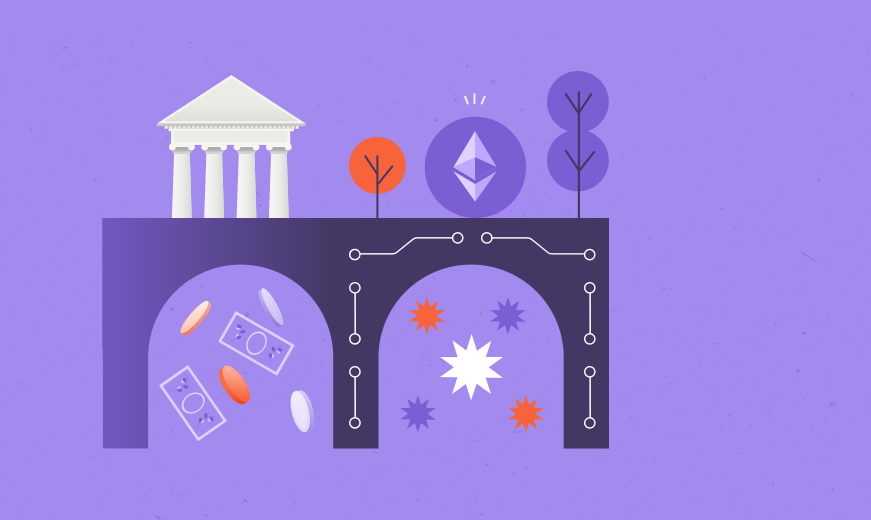
Ethereum is named after the term "aether," which in Greek philosophy refers to an invisible substance that permeates space. The founder, Vitalik Buterin, chose this name to symbolize that Ethereum, as a platform for decentralized applications, serves as a bridge between the traditional and the new decentralized world.
✅ Decentralized financial transactions: Ethereum enables a variety of decentralized financial applications such as loans, insurance, decentralized exchanges, and investment funds. A prime example of such a decentralized financial application on Ethereum is Uniswap, a platform for trading cryptocurrencies. On Uniswap, users can trade tokens directly from their Ethereum wallet, which significantly simplifies usage and access.
✅ Identity management: Thanks to Ethereum, users can verify and own their identity on the blockchain, eliminating the reliance on centralized identity management systems. A standout example of identity management on Ethereum is uPort, a self-sovereign identity (SSI) platform. This allows users to securely and decentrally manage their identity on the Ethereum blockchain, setting new standards for security and privacy.
✅ Ownership in gaming: Ethereum enables the development of decentralized games that grant users full control over their in-game assets and ownership. A notable example of a decentralized game on Ethereum is Axie Infinity. Here, users can breed digital monsters and compete in exciting battles. The unique aspect is that players own their digital monsters and can even trade them on the Ethereum marketplace, opening up an entirely new dimension of gaming and ownership.
✅ Transparency in logistics: Ethereum can be used to track supply chains and reduce fraud by providing a transparent record of all transactions. An example of logistics on Ethereum is the company Ambrosus, which has developed a blockchain solution for monitoring food supply chains. The Ethereum blockchain is used to record all transactions and ensure a transparent and reliable record.
✅ Decentralized autonomous organizations (DAOs): Ethereum can be used to create DAOs (Decentralized Autonomous Organizations), which function as decentralized companies and make decisions based on member votes. An example of a DAO on Ethereum is Aragon, a platform for creating DAOs that allows members to make decisions about the direction and management of their decentralized organization.
Thus, Ethereum is much more than just another cryptocurrency. As you can see, there are numerous other crypto projects based on the Ethereum platform. Many of these projects leverage the advantages of smart contracts to create decentralized applications that offer users greater control and transparency. Ethereum is therefore an essential foundation in the cryptocurrency universe.
This article constitutes neither investment advice nor a solicitation to buy or sell crypto-assets or other financial instruments or to enter into any other financial transactions. The primary purpose of this article is to provide general information. No representations or warranties, express or implied, are made regarding the fairness, accuracy, completeness, or correctness of this article or the opinions contained therein. Therefore, it is not advisable to rely on the fairness, accuracy, completeness, or correctness of this article or the opinions contained therein. Some statements in this article may contain forward-looking expectations based on our current assessments and assumptions. These statements are subject to uncertainties and may cause actual results, performance, or events to differ from the statements made in this article.
Cryptonow and all persons advising or representing it cannot be held liable in any way for this article. It is important to note that investments in crypto-assets carry both risks and opportunities.