Paying with Bitcoin in the store.
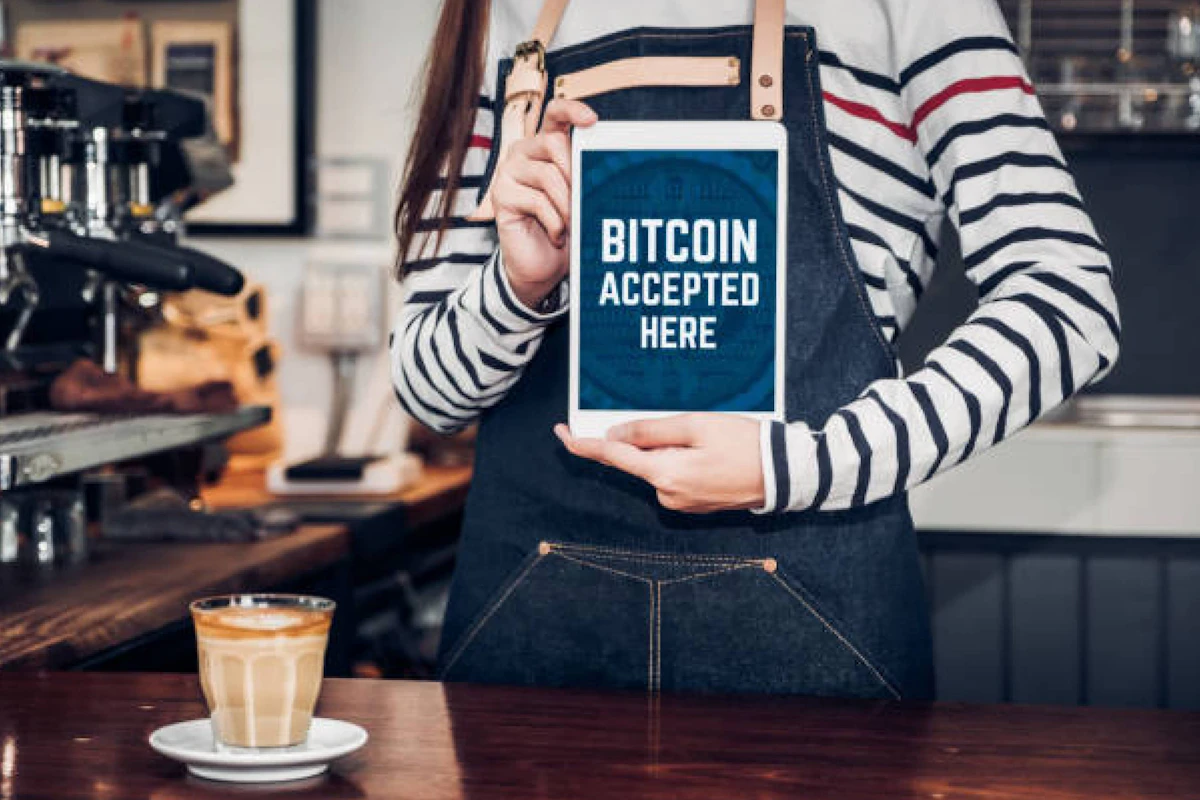
Cryptocurrencies are becoming part of our normality. More and more companies are accepting them as a form of payment. Increasingly, you can see a Bitcoin logo at the entrance doors of shops. In El Salvador, Bitcoin has even become an official national currency. In this article, you will learn how to pay with cryptocurrencies in stores.
When
was introduced in 2009, no one could have predicted the triumph it would achieve. At that time, Bitcoin was much less known and people asked, "What is Bitcoin and how does it work?" Today, it and other cryptocurrencies, such as Ethereum, Solana, or Ripple, are soon to be part of our economic system.From international mail-order companies to travel providers and pizza delivery services: More and more businesses are enabling online payments with cryptocurrencies. And for those traveling in cities like Berlin or Amsterdam, the “Bitcoin Accepted Here” stickers on cafes or smaller shops are becoming increasingly common.
Here is a brief guide on how payment with Bitcoin & Co. works:
First, you need a digital wallet for cryptocurrencies, known as a "wallet." For example, the Cryptonow app. There are various providers for a Bitcoin wallet, each with different advantages and disadvantages. It's best to compare different providers like the Metamask Wallet, Exodus Wallet, or the Cryptonow app to find the crypto wallet that best suits your needs.
After that, you need to find a local shop or business that accepts crypto assets as a means of payment. In the EU, there is a growing number of retailers and service providers that accept crypto assets as payment. Here you can find a map with stores that accept Bitcoin.
To make a payment, the cryptocurrency must be transferred from your wallet to the company's wallet. Often, all that is required for the payment is scanning a QR code that contains the receiving address.
Now, simply select the currency, enter the amount, send it, and you're done! It's important to note the current Bitcoin price at the time of purchase. It is advisable to pay with cryptocurrencies like Bitcoin or Ethereum when the exchange rate is high. Conversely, when the exchange rates are low, it's better to buy cryptocurrencies rather than spending them.
The world's most expensive pizza
In 2010, Laszlo Hanyecz bought two pizzas with 10,000 Bitcoins when the cryptocurrency was still relatively new and practically worthless. Today, with a Bitcoin worth thousands of dollars, this purchase is considered the most expensive pizza in the world.
Bitcoin, Ethereum, and other cryptocurrencies can do much more. They have the potential not only to revolutionize the payment process in local shops or online stores, but also to serve as exciting alternatives for the following areas:
Remittances. Many people with relatives abroad regularly send them money. The specialized transfer agencies used for this are often expensive. In contrast, sending cryptocurrencies is almost free.
Micropayments. Transferring small amounts of money in the traditional way is cumbersome. This is not the case with crypto transactions. For example, they are useful for quickly paying a few cents to read a single article ("Pay-per-View").
The greatest benefit is the direct transaction between buyer and seller without the need for a bank ("peer-to-peer"). This is faster, cheaper, and more efficient. Another advantage is the global uniformity of payments. There are no restrictions such as bank hours, exchange rates, or fees for international transfers. And finally, transactions in cryptocurrencies are pseudonymous. This means that although the transactions can be transparently seen on the
, it is not automatically known who is behind the wallets. A major plus for those who value privacy.This article constitutes neither investment advice nor a solicitation to buy or sell crypto-assets or other financial instruments or to enter into any other financial transactions. The primary purpose of this article is to provide general information. No representations or warranties, express or implied, are made regarding the fairness, accuracy, completeness, or correctness of this article or the opinions contained therein. Therefore, it is not advisable to rely on the fairness, accuracy, completeness, or correctness of this article or the opinions contained therein. Some statements in this article may contain forward-looking expectations based on our current assessments and assumptions. These statements are subject to uncertainties and may cause actual results, performance, or events to differ from the statements made in this article.
Cryptonow and all persons advising or representing it cannot be held liable in any way for this article. It is important to note that investments in crypto-assets carry both risks and opportunities.