Crypto helps people without access to traditional banks.

Savings accounts, loans, and affordable money transfers – these are out of reach for many people without access to the banking system. Bitcoin and other cryptocurrencies are accessible to anyone with an internet connection. They promote fair financial services, social equity, and economic growth. Let us show you how Bitcoin and other cryptocurrencies foster financial inclusion.
Salary accounts, savings deposits, pensions, cash from ATMs, and online payments – for most of us, these are part of everyday life. But not for 1.4 billion adults worldwide. This nearly one-fifth of the global population lacks access to banking services or other regulated financial institutions. This means that every fifth person cannot simply deposit their savings in an account, send or receive money, or take out loans. The lack of financial services not only restricts access to basic banking but also hinders the economic development and social mobility of many communities.
In this context, Bitcoin and other cryptocurrencies can play a transformative role by enabling access to financial services for the unbanked, thereby fostering financial inclusion and social equity. Bitcoin and similar cryptocurrencies can make a significant contribution to financial inclusion because they are globally accessible without the need for intermediaries, regardless of nationality or wealth.
One in five people worldwide has no access to banking services. Thanks to cryptocurrencies and decentralized technology, anyone with an internet connection can participate in the financial system.

"Financial inclusion" means that everyone has access to financial services under fair conditions. With access to financial services, we can invest in education or health or start businesses. Financial inclusion helps reduce poverty by enabling people to save money, take out loans, and access insurance. It promotes greater income equality and is a key driver of economic growth, as it allows more people to participate in the formal financial system, thereby unlocking potential for productivity and innovation.
You can imagine that people without access to banks face numerous challenges. They may be forced to rely on expensive private loans because, without a bank account, they are not eligible for a bank loan. For payments, they often resort to traditional money transfers or checks, incurring high fees. Additionally, bureaucracy poses significant obstacles: in remote areas, for example, someone might have to travel an entire day just to collect their paycheck. Millions of people also lack identification documents, which are necessary to open a bank account. These barriers result in financial exclusion and limit access to basic financial services, hindering the economic and social development of many communities.
And how do cryptocurrencies help? Crypto transactions are based on decentralized and transparent blockchain technology, operating peer-to-peer without intermediaries like banks. This makes crypto transfers fast, secure, and affordable. Everyone can access blockchain-based services such as lending, savings, or insurance. Additionally, secure digital identities can be created for identification purposes. In short: with just an internet connection, anyone worldwide can participate in the global economy. Thanks to this innovative technology, financial inclusion becomes a reality, allowing even those without a bank account to benefit from the advantages of digital finance.
Stablecoins and central bank digital currencies (CBDCs) also provide people without bank accounts access to digital financial services, connecting them globally. This is fair, supports social justice, and helps combat poverty. In turn, this promotes economic growth and innovation, benefiting everyone. Many believe that cryptocurrencies and decentralized technologies represent the future of inclusive finance. These progressive approaches are crucial for building a fairer society and ensuring financial participation for all.

In short: financial inclusion with crypto
Around 20% of the world’s population has no access to traditional banking services. By using cryptocurrencies and decentralised technologies, however, anyone with an internet connection can participate in the global financial system. Here’s how.
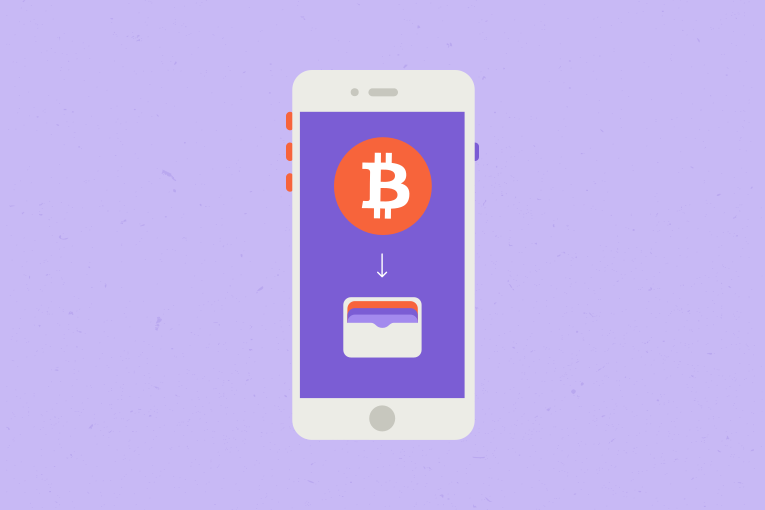
Mobile Wallets
A mobile Wallet – basically a digital purse – allows anyone with internet access to receive money transfers, pay bills, or withdraw cash at authorized locations.
Microloans
Borrowers are connected directly with lenders and benefit from the transparency and security of blockchain. This makes it possible to issue microloans over the internet to small businesses and individuals, especially in developing countries.

Identity solutions
Platforms use the decentralized nature of blockchain to store and manage digital identities. This allows users to identify themselves digitally and share information securely and transparently. As a result, anyone with internet access can, for example, apply for loans and participate in the formal economy.
Sources and further reading
- Cointelegraph: The role of cryptocurrency in advancing financial inclusion
- Givepact: How Crypto Is Driving Financial Inclusion in Developing Countries
This article constitutes neither investment advice nor a solicitation to buy or sell crypto-assets or other financial instruments or to enter into any other financial transactions. The primary purpose of this article is to provide general information. No representations or warranties, express or implied, are made regarding the fairness, accuracy, completeness, or correctness of this article or the opinions contained therein. Therefore, it is not advisable to rely on the fairness, accuracy, completeness, or correctness of this article or the opinions contained therein. Some statements in this article may contain forward-looking expectations based on our current assessments and assumptions. These statements are subject to uncertainties and may cause actual results, performance, or events to differ from the statements made in this article.
Cryptonow and all persons advising or representing it cannot be held liable in any way for this article. It is important to note that investments in crypto-assets carry both risks and opportunities.