Crypto vs. the ECB's digital euro.
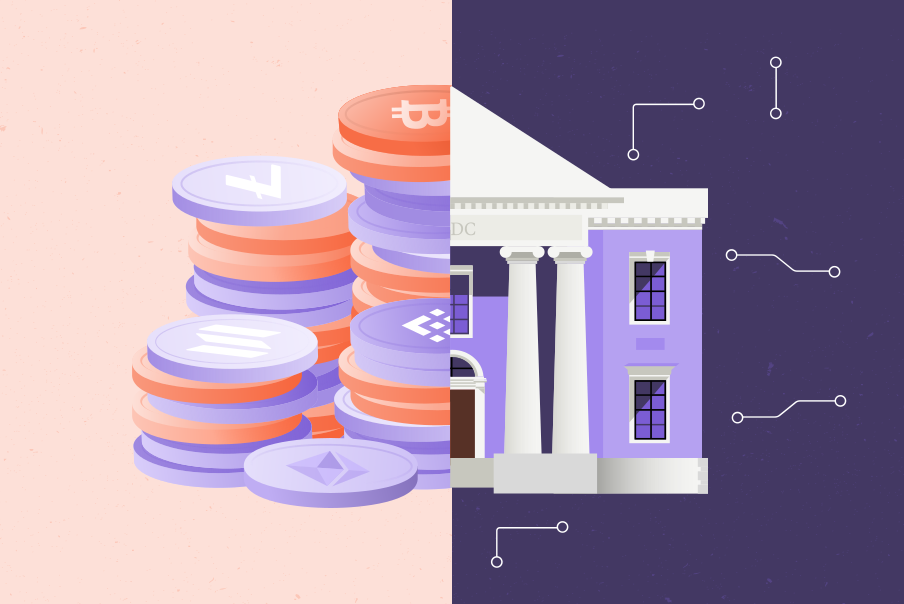
Both cryptocurrencies and digital central bank money are currently widely discussed topics in the financial world. However, what many people don't know is that these two terms differ significantly from each other. In this article, we will highlight the key differences between cryptocurrencies and digital central bank money.
“No Cash, no Problem,” under this motto, the central bank of Jamaica has issued its digital currency. In fact, you no longer need cash, a bank card, or a bank account when paying with your smartphone using the digital central bank currency. This innovative payment method provides everyone with the opportunity to make payments or transfer money directly anywhere and anytime, without relying on traditional banking services. However, the digital central bank currency differs significantly from cryptocurrencies, as it is issued and regulated by a state institution and is not based on decentralized technologies like blockchain.
Cryptocurrencies like Bitcoin have existed for several years. They could be called "decentralized" or "private" money because they are not issued or controlled by state institutions like the European Central Bank (ECB). Unlike traditional currencies, which are issued and regulated by a central authority such as a central bank, cryptocurrencies are based on decentralized technologies like blockchain. These technologies allow users to conduct transactions directly with one another without relying on intermediaries like banks. These characteristics make cryptocurrencies an innovative and alternative form of payment, used by a growing number of people worldwide. Here you can learn more about the exciting world of cryptocurrencies.
Central banks also want to take advantage of the benefits of digital money transactions. In many countries worldwide, including EU pilot projects such as the digital euro, they are therefore working on their own solution: digital central bank currencies (Central Bank Digital Currency, CBDC). They aim to facilitate money transactions and make them accessible to everyone with internet access. Their idea is based on the concept that everyone would have a universal account directly with the central bank, and the intermediary role of private banks could be eliminated. Like traditional currencies, digital central bank currencies are money. Information on FIAT money can be found here. They are issued by the central bank in unlimited quantities, controlled, monitored, and are legal tender.
Digital central bank money is already being discussed or even in circulation in many countries. However, there are some differences compared to cryptocurrencies. Let's take a look at them:
| Aspect | Cryptocurrencies | Digital Central Bank Currencies (CBDC) |
|---|---|---|
| Currency system | Decentralized | Centralized |
| Issuance/Control | Cryptocurrencies are developed and maintained by open-source communities or companies; control depends on governance model | These are issued by central banks and supported by governments. The central bank decides on the money supply, interest rates, etc. |
| Money supply | Some cryptocurrencies, such as Bitcoin, have a fixed supply limit: The reason for this is to prevent the available supply from getting out of control, which would lead to inflation. | Currently, there is no limit. The central bank can change the money supply at any time, for example, to maintain the stability of the currency system or to control inflation rates. |
| Coverage | They are not connected to conventional legal currencies like the euro. This means their value can fluctuate significantly and is determined by the free market. | CBDCs have the same value as their corresponding physical currencies and could be exchanged 1:1 for banknotes. However, the banknotes themselves, like fiat money, are not backed by a physical commodity. |
| Target group | For all people with internet access worldwide, including those who currently do not have a bank account or access to the banking system. | For all people with internet access worldwide. No bank account is required to use the CBDC. |
CBDCs already in circulation include the Sand Dollar in the Bahamas, Jam-Dex in Jamaica, the digital yuan in China, and the eNaira in Nigeria. Interestingly, the eNaira has struggled to gain traction among the population, partly due to widespread mistrust of the ruling elite. This highlights that the acceptance of central bank digital currencies is influenced not only by technological factors but also by social and political aspects.
Countries such as India, Singapore, Ghana, France, Uruguay, Saudi Arabia, the United Arab Emirates, and Canada are currently in the project phase. Feasibility studies are underway in countries like Hungary, Ukraine, Turkey, Sweden, Norway, and many others worldwide. This broad international interest demonstrates the significance and potential of central bank digital currencies as tools for modernizing the financial system and promoting financial inclusion.
The growing interest and global activity surrounding central bank digital currencies underline the possible benefits and opportunities of this technology. From the Bahamas to China and from Nigeria to Canada, central banks worldwide recognize the potential of digital currencies to improve payment processes, enhance financial inclusion, and strengthen the efficiency of the financial system. While China with its digital yuan is already in an advanced phase of implementation, other players such as the Swiss National Bank (SNB), the European Central Bank (ECB), and the United States Federal Reserve are still in the discussion and evaluation phase. It will be exciting to observe how these developments unfold and what impact they will have on the global economy and financial system.
This article constitutes neither investment advice nor a solicitation to buy or sell crypto-assets or other financial instruments or to enter into any other financial transactions. The primary purpose of this article is to provide general information. No representations or warranties, express or implied, are made regarding the fairness, accuracy, completeness, or correctness of this article or the opinions contained therein. Therefore, it is not advisable to rely on the fairness, accuracy, completeness, or correctness of this article or the opinions contained therein. Some statements in this article may contain forward-looking expectations based on our current assessments and assumptions. These statements are subject to uncertainties and may cause actual results, performance, or events to differ from the statements made in this article.
Cryptonow and all persons advising or representing it cannot be held liable in any way for this article. It is important to note that investments in crypto-assets carry both risks and opportunities.