How Bitcoin protects your savings from inflation.

Certain cryptocurrencies, such as Bitcoin, have the advantage of being influenced only by predictable inflation, unlike our currencies like the euro. We will explain how inflation occurs, how it can be fought, and why cryptocurrencies could be a possible protection against it.
Many people in Europe and worldwide feel the effects of – maybe you do too. Inflation, or rising costs, refers to when the price level for goods and services generally increases. For example, when food, gasoline, rents, and health insurance become more expensive. You notice this when, for example, you paid 500 euros per month for your groceries. With a high inflation rate of 8 percent – as was the case in 2022 – the same purchase would now cost you 540 euros.
We can buy less because our money loses value. Solutions against excessive inflation are therefore in demand. Cryptocurrencies are increasingly being discussed in this context. This is because cryptocurrencies are independent of the current monetary system, meaning they are not controlled by the state or central bank and usually have predictable inflation. They are resistant to manipulable inflation. Why is this the case? Let's first take a look at how inflation can occur.
Today, it is the case that the government and central bank can increase the money supply at any time as needed. If they increase the amount significantly, there is more money in circulation in Austria than what is produced in goods and services nationwide. When there is more money, people want to buy more goods and services. This causes prices to rise, and as a result, money becomes less valuable.
Desired low inflation
What many of us don't know is that the central bank intentionally targets a steady inflation rate of two percent per year with its monetary policy. This has a positive effect on economic growth. However, this also means that our money is intentionally devalued every year. Now, imagine this mathematically. If you deposited 100 euros into your savings account in the year 2000, and inflation was two percent every year, then by 2020, the saved amount would only have the purchasing power of about 67 euros. In 2040, those 100 euros would be worth only 45.29 euros. And if the inflation rate continues to rise, it may be worth even less in old age.
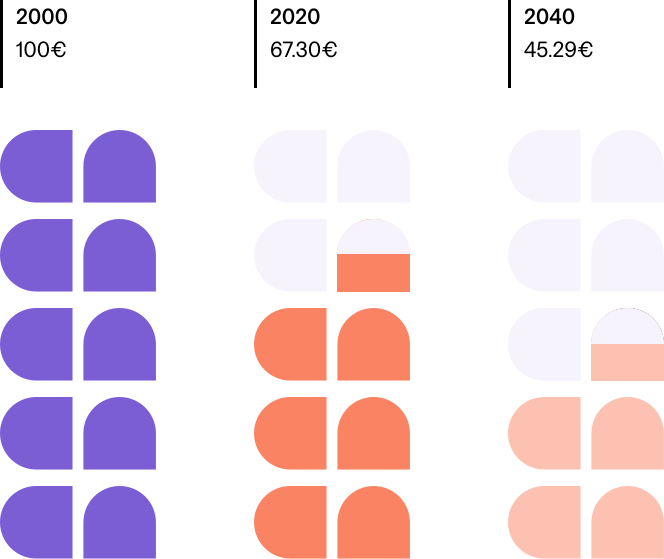
Inflation rate rises
In the European Union, the inflation rate has risen significantly above the targeted 2% in the last two years. In 2022, the inflation rate was exceptionally high at 8.6%. An inflation rate of this level means that money rapidly loses purchasing power over time, leading to a massive devaluation of income. As a result, consumer and investment demand weakens, as people have less purchasing power and can afford less. Let's do the theoretical calculation again, this time with 8% inflation: You deposit 1000 euros into your savings account today. With an annual inflation rate of 8%, your saved amount will have a purchasing power of only 188.69 euros in 20 years.
For this reason, central banks try to reduce high inflation. One of their tools is raising the key . This means that loans become more expensive, and less new money is borrowed. Anyone with a loan or mortgage will have to pay higher interest rates. If they can no longer repay these rates, it would weaken the banks, which in turn could lead to a financial crisis. Therefore, decisions regarding the key interest rate by the ECB are always carefully considered.
Cryptocurrencies offer the opportunity to prevent devaluation. They are managed in a decentralized way by a community of users. Additionally, the total supply of the most well-known cryptocurrencies, such as Bitcoin, is limited, and you can clearly see how many more Bitcoins will be mined. Their supply cannot be arbitrarily increased by a central authority, as is the case in our current monetary system. The scarcity of Bitcoins is essentially already transparent and predetermined, making inflation almost 100% predictable.
As you can see, cryptocurrencies have great potential as an inflation hedge. However, one must also consider that they are exposed to many price fluctuations and may need to be more regulated in the future. Discussions are ongoing. We cannot say today which monetary systems we will trust in the future. In any case, cryptocurrencies allow us to rethink the concept of preserving the value of money.
5.6 billion German marks cost a kilogram of bread in Germany 100 years ago – in November 1923. This was due to the world war and record hyperinflation. The money was worthless.

Sources and further reading:
- Eurostat: https://ec.europa.eu/eurostat/web/hicp
This article constitutes neither investment advice nor a solicitation to buy or sell crypto-assets or other financial instruments or to enter into any other financial transactions. The primary purpose of this article is to provide general information. No representations or warranties, express or implied, are made regarding the fairness, accuracy, completeness, or correctness of this article or the opinions contained therein. Therefore, it is not advisable to rely on the fairness, accuracy, completeness, or correctness of this article or the opinions contained therein. Some statements in this article may contain forward-looking expectations based on our current assessments and assumptions. These statements are subject to uncertainties and may cause actual results, performance, or events to differ from the statements made in this article.
Cryptonow and all persons advising or representing it cannot be held liable in any way for this article. It is important to note that investments in crypto-assets carry both risks and opportunities.