How our money was created and its future.
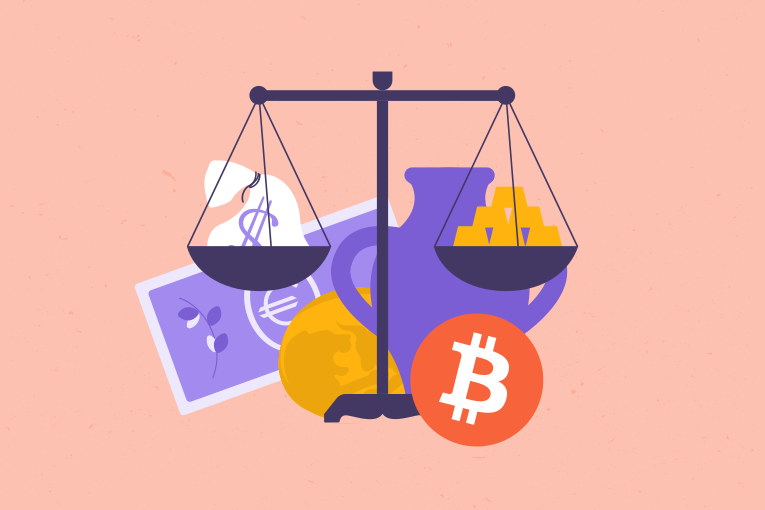
Welcome to the fascinating journey through the history of money! Join us as we explore the evolution of money over the millennia. From the primitive bartering of early humans to the introduction of the gold standard and the emergence of paper currency, the concept of money has continually transformed and evolved.
How do you pay for your groceries at the supermarket? With cash? A bank card? Or perhaps even your mobile phone? Today, we have a wide range of options for conducting transactions. Our monetary system is incredibly dynamic and has been constantly adapting to societal developments for thousands of years.
In short: the history of our money
Our money has taken on different forms over the course of time. Discover the most important milestones in the history of money and explore what the future might hold.

Bartering
Our ancestors once traded clay jugs for stone axes and exchanged services with each other. Later, commodity money was used, such as stone money, shells, spices, precious metals and other natural goods.

Gold and silver coins
The world's first gold coin is almost 3,000 years old. Minted gold and silver coins became a popular means of payment. Each coin had the value of the material from which it was made.

Gold standard
Gold coins were quite heavy and impractical to transport. About 150 years ago, people began exchanging gold coins for money (banknotes and coins). The value printed on the money reflected the value of the gold held in reserve.

Fiat money
What we use today in everyday life is mainly fiat money, such as our euro. Fiat currencies are created by central banks and are not backed by assets.

Cryptocurrency
The current fiat money system is under criticism and there is a controversial debate as to whether it should be replaced by another system. Cryptocurrencies are becoming increasingly popular and could revolutionize the existing financial system.
In the beginning, there was bartering. When our ancestors wanted something, they traded for it. A clay jug for a stone axe. But what if no one needed a clay jug? Or if someone preferred to trade the jug for a bow and arrow instead of a stone axe? In that case, they had to travel from village to village until they found a suitable trade partner. This was exhausting and time-consuming. That’s why money was invented as a medium of exchange. Money is a currency accepted by everyone. For instance, one could trade a clay jug for money and then use the money to buy a bow and arrow. However, the first money was not comparable to today’s currency. In the past, people used stone money, grain, spices, or shells as payment. Wealth back then meant owning many shells, for example. Later, people began using gold and silver for payment. These forms of payment are known as commodity money. They not only had exchange value but also intrinsic value – the value of the commodity itself.
The concept of commodity money may have facilitated trade, but it also brought its own challenges. Traders had to carry heavy sacks of shells or use separate scales for spices and grain, making trade inconvenient and labor-intensive. Around 3,000 years ago, the first coins were introduced as a solution to these problems. These coins, usually made of gold or silver, were stamped with the ruler's mark and their value. They represented the value of the material itself and made the exchange of goods much easier.
The idea of metal coins quickly spread and revolutionized trade. However, they also had their disadvantages, particularly their weight and bulkiness. Around 150 years ago, the concept of paper money, known as gold certificates, was developed. These receipts represented the value of the gold they secured and made trade easier for people, as they were much lighter to transport than gold coins. This marked the invention of the first paper money!
The introduction of paper money marked a turning point in the history of money and paved the way for modern currency systems. It enabled easier trade and the secure transfer of value over long distances. Today, in an increasingly digital world, money has continued to evolve, and electronic payment methods such as credit cards and mobile wallets are becoming increasingly popular.
Over time, gold certificates evolved into our modern currencies, such as the US dollar. These currencies are no longer directly tied to the value of gold or other precious metals but are instead based on public trust and the stability of their respective economies. The state assigns
the task of issuing money. But in what quantity? In the past, during the era of the gold standard, a country's currency was directly tied to the value of gold, which provided a certain level of stability in financial markets. This meant that the amount of money in circulation was limited by the available gold reserves. The gold standard was an integral part of many economies and required that every issued banknote or coin be backed by a corresponding value in gold.This monetary system was not only a measure of financial security but also a symbol of economic power and stability. The luster of gold lent currencies a certain value and made them highly sought-after assets. Many countries, including the United States, Great Britain, and Germany, adhered to the gold standard and regularly conducted gold transactions to support their currencies.
However, the gold standard also came with its challenges. The limited availability of gold reserves often led to shortages in the money supply and restricted the economic flexibility of central banks. Additionally, sudden changes in gold prices and gold production posed potential risks to the stability of the entire financial system.
Over time, most countries abandoned the gold standard and transitioned to fiat currencies, where the value of the currency is no longer directly tied to the value of gold. This shift allowed central banks to implement more flexible monetary policies and respond more swiftly to economic changes. Nevertheless, the gold standard remains a fascinating chapter in the history of money and a significant milestone in the development of modern economic systems.
The gold standard has one major drawback: you can only produce as much money as there is gold in reserve. Global gold supplies—and thus the wealth of nations—are limited. Over time, however, the need arose to spend more money than there were gold reserves available. This led to the development of a more flexible monetary system: the system we know today, commonly referred to as the fiat money system. In the European Union, for example, this is the euro.
What makes this system unique is that governments now have the freedom to control the money supply. They do this by printing currencies or creating them electronically. You can probably guess that this comes with certain risks: with the fiat money system, states can theoretically accumulate unlimited debt. If too much money is printed, the value of the currency can decrease, potentially leading to
. Political instability and economic uncertainty can also affect the value of a fiat currency.Have you ever wondered where the value of today’s money actually comes from? Sure, coins, and banknotes have the value printed on them. However, unlike commodity money, they have no intrinsic material value. So what makes a 10-euro note worth 10 euros? Quite simply, it’s our trust that gives money its value. We trust in the value of central bank currency, simply by collectively accepting that we can exchange a certain amount of money for goods and services.
The current fiat money system, controlled by governments and central banks, is under scrutiny, and there is ongoing debate about whether it should be replaced by a different system. At the same time, technological progress is opening up new possibilities. Cryptocurrencies have gained significant traction in recent years and are being accepted by an increasing number of countries, merchants, and businesses.
Whether cryptocurrencies will replace the current monetary system or remain an alternative is uncertain, as many factors come into play: developments in the financial sector, technological advancements, politics, and the economy. What is certain, however, is that the future of money will continue to be shaped by the needs and demands of society and driven by advanced technologies and innovative ideas.
Learn more about how cryptocurrencies could revolutionize the current financial system.
This article constitutes neither investment advice nor a solicitation to buy or sell crypto-assets or other financial instruments or to enter into any other financial transactions. The primary purpose of this article is to provide general information. No representations or warranties, express or implied, are made regarding the fairness, accuracy, completeness, or correctness of this article or the opinions contained therein. Therefore, it is not advisable to rely on the fairness, accuracy, completeness, or correctness of this article or the opinions contained therein. Some statements in this article may contain forward-looking expectations based on our current assessments and assumptions. These statements are subject to uncertainties and may cause actual results, performance, or events to differ from the statements made in this article.
Cryptonow and all persons advising or representing it cannot be held liable in any way for this article. It is important to note that investments in crypto-assets carry both risks and opportunities.